
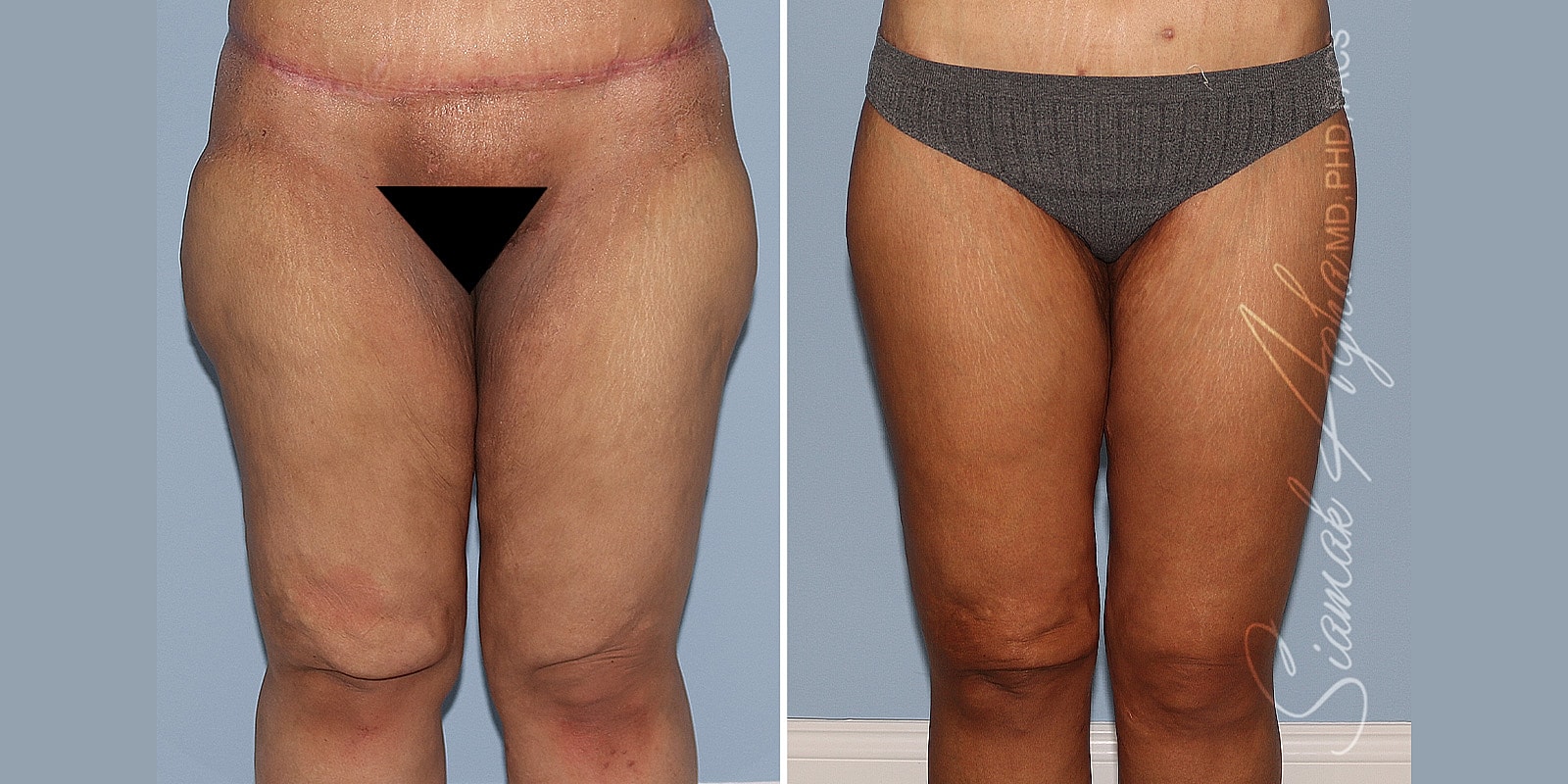
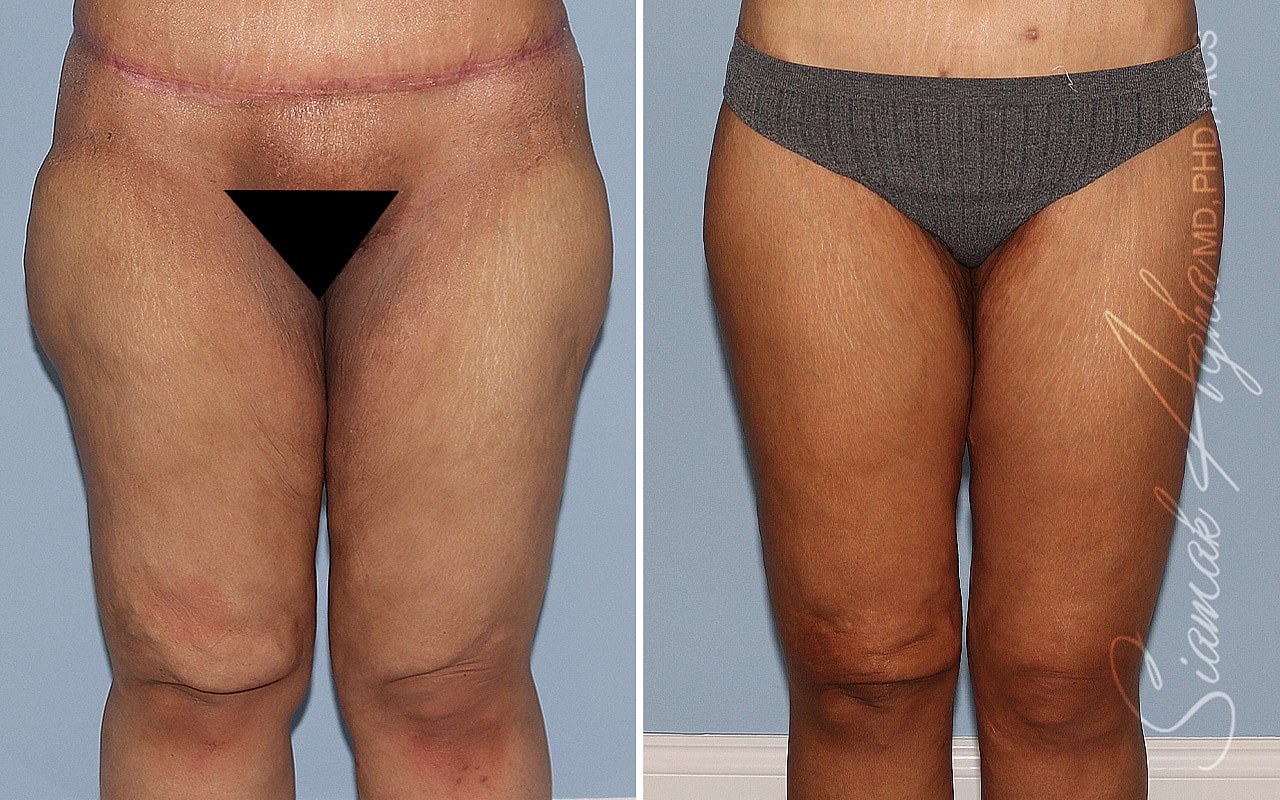
After losing 141 pounds, this female patient in her mid-30s had dramatically changed her body, reducing her weight from 287 to 146 pounds. What remained, however, was substantial loose skin throughout her thighs and lower body.
Her thighs remained wide because of excess skin and tissue extending from the groin toward the knees. She also had fullness through the saddlebags and upper inner thighs, along with distinctive folds of loose skin immediately above both knees.
The fold above the right knee was especially pronounced. That small area became one of the most interesting parts of her transformation.
A separate knee lift was considered during her original surgical planning, but was ultimately never performed. Instead, Dr. Siamak Agha treated her lower body in two stages: first with a Vertical Thighplasty, or Thigh Reduction, and approximately four months later with a High-Definition Lower Body Lift™. These operations were designed primarily to reduce excess thigh tissue and reposition the surrounding lower-body tissues, not as a direct knee-lift procedure. Yet their combined effect produced a meaningful improvement in the sagging skin above her knees.

After major weight loss, not all thigh laxity behaves in the same way. Some loose tissue primarily drops downward from the upper thigh. In selected patients, that may be addressed through a thigh lift with an incision positioned high within the groin crease.
This patient's problem was more extensive. She also had circumferential laxity, meaning there was excess tissue around the width of the thigh itself. Her excess extended from the groin down the inner legs and toward the knees.
She had significant looseness throughout the thighs, saddlebags, upper-inner-thigh fullness, excess tissue around the front of the knees and folds immediately above both knees, with the right side being more pronounced.
A short groin incision could not adequately remove that degree of excess. That is why Dr. Agha recommended a different operation.
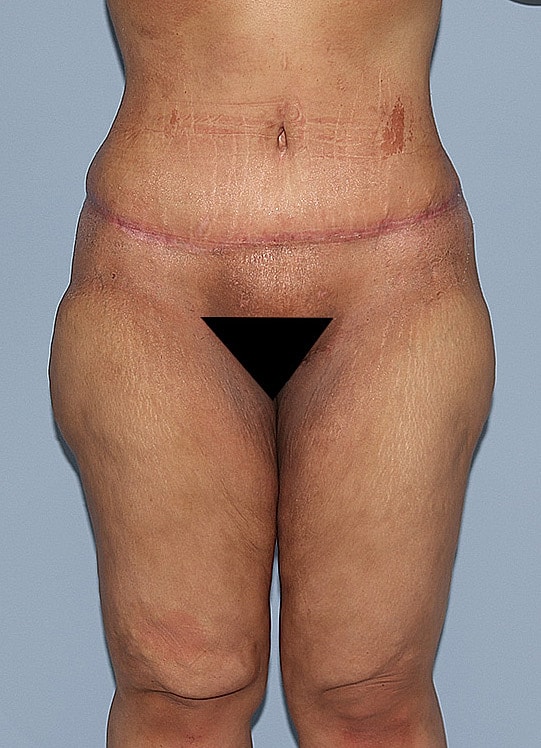
Although this procedure is often called a Vertical Thigh Lift, Dr. Agha prefers the terms Vertical Thighplasty or Thigh Reduction because they better describe what the operation actually accomplishes. The incision runs vertically, but the primary purpose of the operation is not simply to pull the thigh upward. It is to reduce the circumference and overall width of the thigh by removing excess tissue along the inner leg.
For this patient, Dr. Agha designed an incision beginning near the pubic area and continuing down the inner thigh toward the knee. Its length was customized according to how far her excess tissue extended. During surgery, approximately 11 centimeters of excess skin was removed from each inner thigh.
Dr. Agha also used targeted liposuction to contour the upper inner thighs, saddlebags and areas immediately above the knees. Because the right side had more fullness and a more pronounced knee fold, the treatment was adjusted to her natural asymmetry rather than applying exactly the same amount of contouring to both legs.
The first stage substantially reduced the circumference of the thighs and removed excess tissue that a groin-only thigh lift could not have reached.
View Her Vertical Thighplasty / Thigh Reduction Before & After Gallery

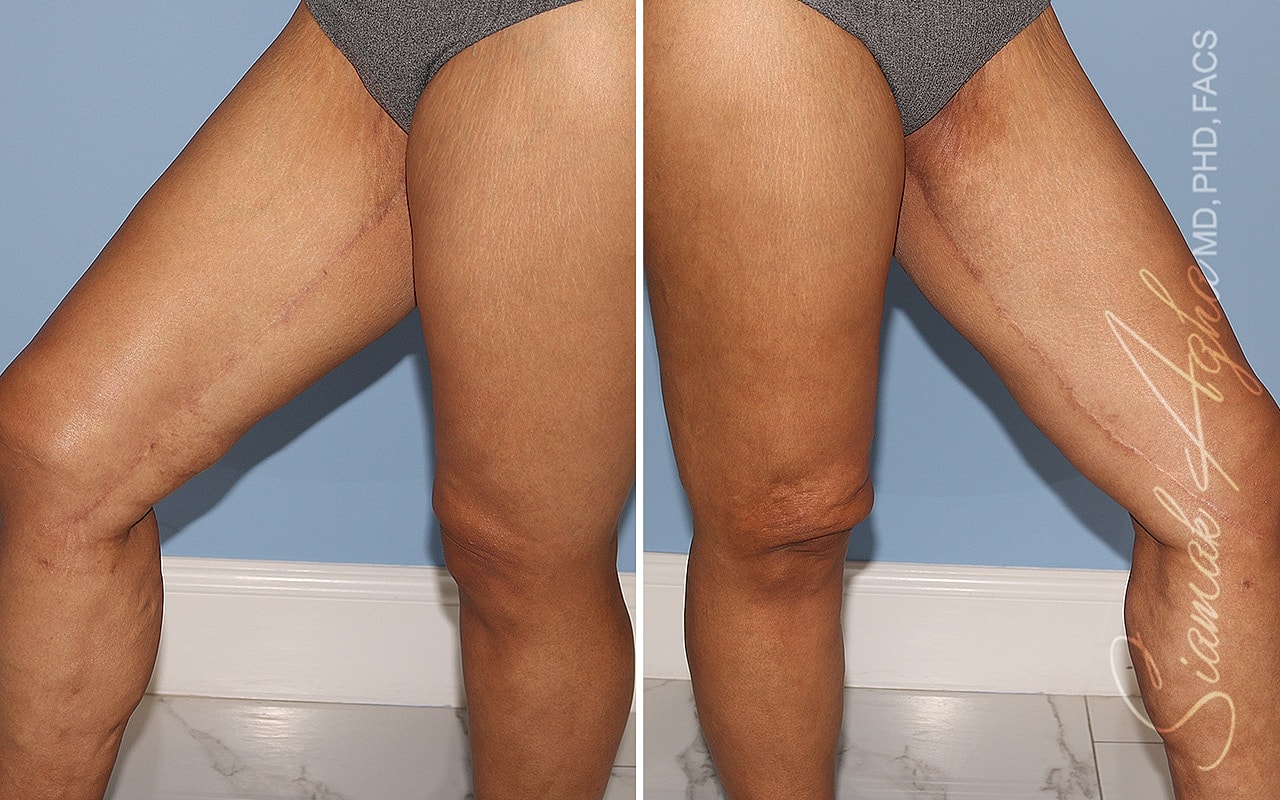
One of the most important tradeoffs of a comprehensive Thigh Reduction is the scar required to achieve it. If excess skin is concentrated only at the top of the thigh, a shorter incision may be sufficient. This patient's loose tissue continued much farther down her legs.
Stopping the incision substantially higher would also have stopped the reduction higher. Dr. Agha therefore continued the tissue removal down the inner thighs toward the knees, bringing the correction much closer to the folds that concerned her.
This was not a knee lift. No separate section of knee skin was directly excised. Instead, the longer Thigh Reduction allowed excess tissue to be removed farther down the leg than would have been possible through a traditional groin-only thigh lift.
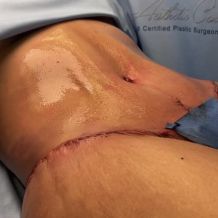
The mature scar photograph also shows the honest tradeoff involved: a longer inner-thigh scar in exchange for a degree of circumferential reduction that a shorter incision could not provide.

By the time this patient was preparing for her second operation, she had already completed her Thigh Reduction. The now less prominent fold above the right knee remained an important concern, and Dr. Agha discusses it directly during the surgical-planning portion of her Lower Body Lift video.
He also explains why the area is difficult to correct from above. A thigh lift creates its strongest effect closer to the area where the tissues are being elevated. As that lifting effect travels farther down the leg toward the knee, it becomes progressively weaker.
For that reason, Dr. Agha did not present the upcoming Lower Body Lift as a predictable way to eliminate the knee fold. The objective was to reposition the broader thigh and lower-body tissues and then determine how much additional improvement would extend toward the knee.
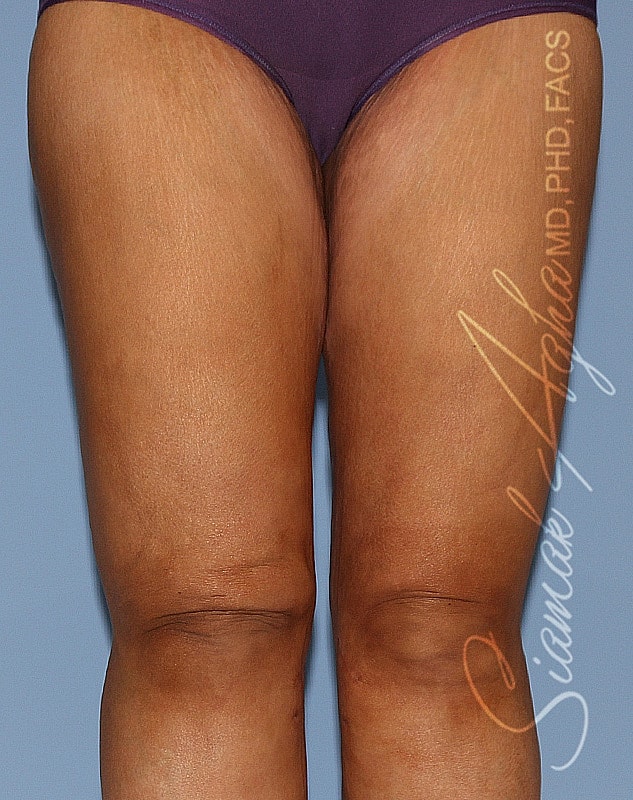
Approximately four months after her Vertical Thighplasty, the patient returned for the second stage of her lower-body transformation. She had previously undergone a tummy tuck in Iran, and her abdomen did not require a completely new abdominoplasty. Instead, Dr. Agha incorporated revision and lowering of the existing tummy tuck scar into a broader High-Definition Lower Body Lift™.
This second operation addressed the pubic area, front and outer thighs, waist, lower back and buttocks. The distinction between the two stages is important: the Vertical Thighplasty had reduced the width of the thighs, while the Lower Body Lift would now help change the position of the tissues around them.
On the front of the body, Dr. Agha revised the previous tummy tuck scar and lifted the pubic area. He also selectively separated the skin and fat of the front thighs from some of their deeper attachments to the underlying tissues. This gave the thigh tissue enough mobility to be repositioned upward rather than remaining tethered in its lower position.
The front thighs were then elevated and secured at a higher level near the pubic bone. The outer thighs were also released sufficiently to allow upward movement and were anchored higher. From the back, the operation included a buttock lift, buttock augmentation using the patient’s own lower-back tissue, fat transfer to the buttocks and liposuction of the waist, lower back, flanks and residual saddlebag areas.
View Her High-Definition Lower Body Lift™ Before & After Gallery
What makes this patient’s journey especially interesting is that there was no single maneuver performed directly on the knee fold that completely explains the final result. Instead, several changes occurred along the same connected region of the leg.
The first operation removed a long section of excess tissue along the inner thigh, extending much closer to the knee than a conventional upper-inner-thigh lift. That reduced the amount of redundant tissue surrounding the lower thigh. Dr. Agha also performed targeted liposuction immediately above the knees, with more treatment on the right side where the fold and fullness were greater.
During the Lower Body Lift, the front thigh tissues were then released from some of their deeper attachments and repositioned upward. The lifting effect was strongest closer to the upper thigh and progressively weaker as it approached the knee, exactly as Dr. Agha explained before surgery. However, because the lower thigh remained connected to the tissues being repositioned above it, some of that change in tissue distribution extended farther down the leg.
The outer thighs were elevated at the same time, changing the relationship between the waist, hip, front thigh, outer thigh and lower leg. Rather than attempting to cut out one isolated fold above the knee, the operation changed the position of the broader thigh structure around it.
The two stages therefore worked in different but complementary directions. The Vertical Thighplasty reduced excess around the thigh, while the High-Definition Lower Body Lift™ repositioned the remaining thigh tissues upward. Together, those changes produced a meaningful improvement in an area that neither operation was specifically designed to correct directly.

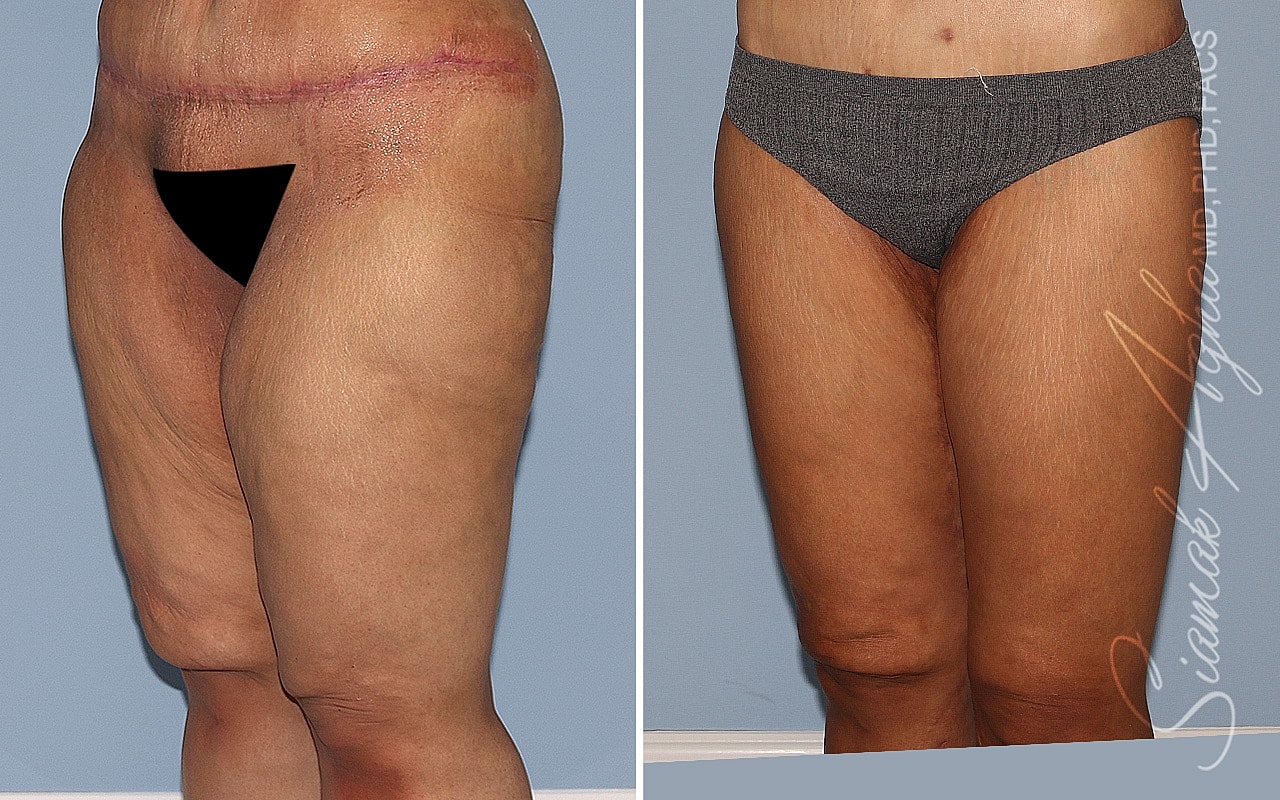
The difference is particularly visible above the patient’s right knee. Before treatment, the excess skin formed a pronounced fold immediately above the joint. In the final photographs, that fold is substantially reduced and the transition from the lower thigh into the knee appears smoother.
There is still normal skin texture and some residual laxity, which is important to acknowledge. This case should not suggest that a Thigh Reduction or Lower Body Lift™ can predictably substitute for a dedicated knee lift in every patient. The amount of improvement that reaches the knee depends on the location and severity of the loose skin, tissue quality, incision length, how extensively the thigh can safely be mobilized, the direction of the lift and how the individual patient heals.
For this patient, however, the cumulative improvement was meaningful enough that a dedicated knee lift was never ultimately performed during this stage of her transformation.
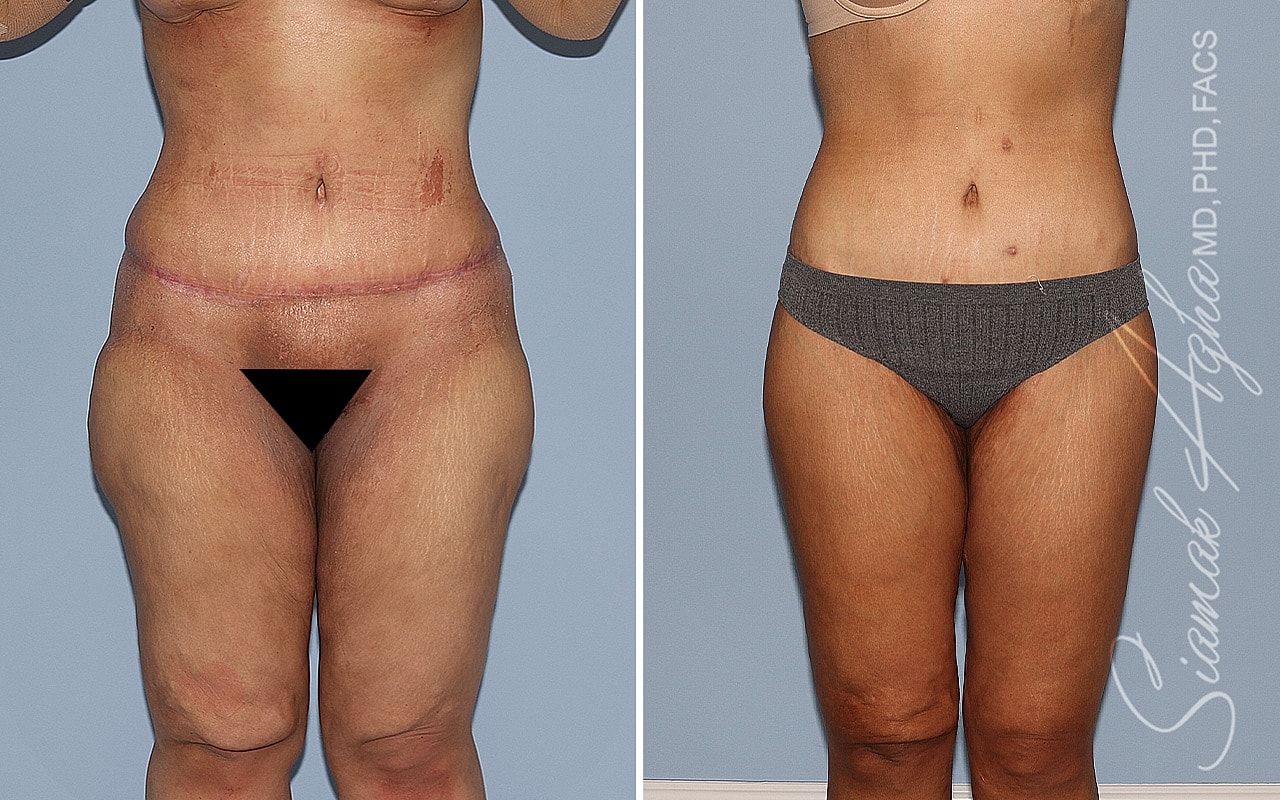
The improvement around her knees is only one part of the final result. Her Vertical Thighplasty substantially reduced the width and heaviness of the inner thighs, creating a straighter contour from the groin toward the knees. The later High-Definition Lower Body Lift™ then addressed the areas surrounding that first-stage result.
From the front, the waist is narrower, the pubic area is elevated and the front and outer thighs sit higher. From behind, the buttocks have been lifted while retaining and restoring fullness using the patient’s own tissue and fat. The lower back and waist also transition more smoothly into the hips and thighs.
Rather than asking one procedure to correct every dimension of post-weight-loss laxity, Dr. Agha used two operations with different purposes to build a more complete lower-body contour.
View Her High-Definition Lower Body Lift™ Before & After Gallery
The first stage addressed circumferential excess, meaning how much loose tissue surrounded the thighs themselves. The second addressed vertical displacement, meaning where the remaining tissues of the front and outer thighs, pubic area and buttocks were positioned.
Staging the operations also allowed Dr. Agha to evaluate what remained after the Thigh Reduction before designing the second procedure. That was particularly relevant around the knees, where a separate knee lift had initially remained a possibility.
Rather than assuming she would need another operation specifically for that area, Dr. Agha completed the planned thigh and lower-body work and evaluated how her tissues responded. The final result showed substantially more improvement above the knees than might have been expected from an upper-thigh lift alone.
Post-weight-loss thighs cannot always be treated with one standard “thigh lift.” The appropriate operation depends on where the loose tissue is located, how far it extends down the leg and in which direction the tissues need to move.
Some patients primarily need an upper inner-thigh lift. Others need substantial circumferential reduction along the length of the thigh. Still others have laxity involving the front, outer or posterior thighs that is better treated as part of a broader lower-body operation.
This patient had several of those patterns simultaneously. Dr. Agha performs more than 36 thigh procedures annually and approximately 27 lower body lifts and lower body lift revisions each year, giving him extensive experience distinguishing between different patterns of post-weight-loss laxity and designing surgery around the patient’s actual anatomy rather than applying the same operation to every thigh.
At The One Plastic Surgery in Newport Beach, Orange County, that approach meant treating this patient in a logical sequence: first reducing the thighs, then repositioning the lower body around them. The improvement above her knees became one of the most interesting results of that staged strategy.
It can in selected patients, but the amount of improvement varies considerably. In this case, the Vertical Thighplasty extended down the inner thighs toward the knees and included targeted liposuction above the knees. The later High-Definition Lower Body Lift™ then repositioned the front and outer thighs upward, and together those changes produced meaningful improvement without a dedicated knee lift.
No. A possible knee lift was discussed during her original surgical planning, but one was never ultimately performed. Her improvement around the knees followed the staged combination of Vertical Thighplasty and High-Definition Lower Body Lift™.
Her excess tissue extended far down the inner thighs rather than being confined to the groin. A shorter incision would also have limited how far down the leg Dr. Agha could directly remove circumferential excess. The incision length was therefore customized according to the location of her loose skin rather than chosen from a fixed template.
The primary purpose of the procedure is to reduce the circumference and width of the thigh. A long section of excess tissue is removed along the inner thigh, and the remaining tissues are brought together to create a narrower leg. Although the incision runs vertically, the operation does not work primarily by pulling the thigh upward.
The surgeries addressed different components of her anatomy. The Vertical Thighplasty reduced excess around the circumference of the thighs, while the High-Definition Lower Body Lift™ later repositioned the front and outer thighs and treated the pubic area, waist, lower back and buttocks. Together, the two operations produced a more comprehensive correction than either procedure was designed to accomplish alone.
Please follow us @drsiamakagha to learn what makes Dr. Agha unique and special, learn from his educational podcasts and consults, and view precision surgery after surgery.